Welcome to The Complete Guide to Sales Planning
In the sector of sales, two key terms are as closely related and linked as “brick and mortar”, or “cause and effect”. And there is nothing random about those pairing examples, either. Territory planning and quota allocations are built into the very foundations of sales strategies and behaviors. Therefore, understanding what they are both as separate concepts and in unison is vital. From that, it's possible to appreciate what smarter sales planning can bring to your business and why a tailored software solution can eliminate those bruising pain points, such as repeated spreadsheet error and unbalanced territories which result in mistrust within your sales team.
This guide covers more than territory and quota planning basics; not only will we recap and say farewell to the plethora of issues that come with an insufficient strategy; it clears a path to the multitude of benefits and advantages a smarter planning solution can deliver.
- Overcome growing pains
- Identify and eliminate sales planning pain points
- Learn the benefits of a smarter planning solution
What's Inside
What is Sales Territory Planning? What is a Sales Quota? Common Issues with Sales Planning
Problem? Here's your Sales Planning Software Answer
What is Sales Territory Planning?
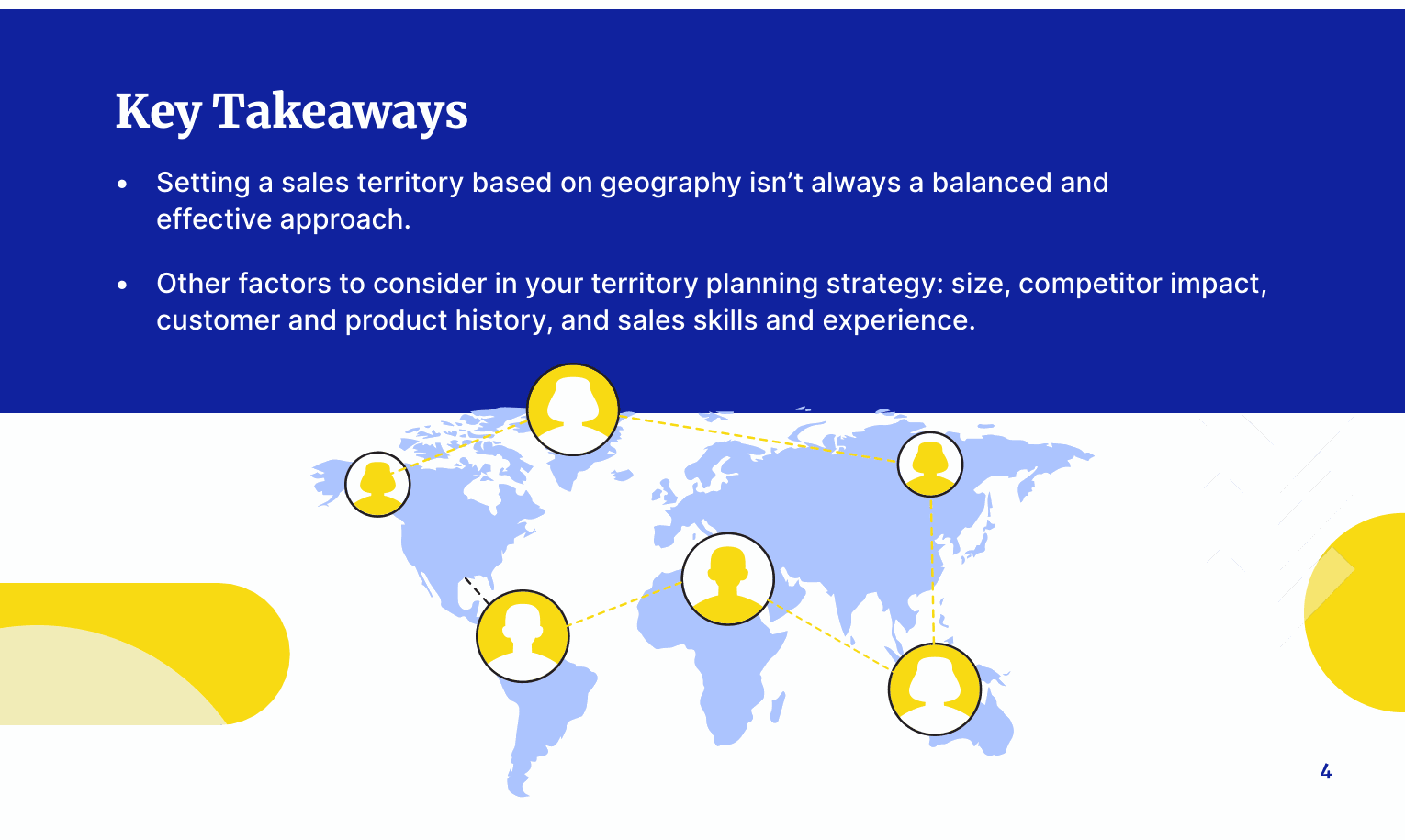
Sales territory planning or management is the creation and maintenance of a designated sales area or region with the intention that each one is as effective and profitable as possible. While the classic model of setting these was a geographical one, this was not always reliable or fair. Picking up on a theme that we'll return to, a common issue is that one territory could be defined as a large state, but it may have a relatively small population. Or the problem could be that the demographic hadn't been researched thoroughly enough during the early pre-setting stages. Conversely, a densely populated area that is smaller may require a larger sales team to manage sales and accounts.
A robust territory planning strategy covers much more than simple geography. Not only does it factor in size, but also the impact of competitors within a territory, previous customer, and product history, in addition, which sales professionals in a team have the right skills and experience for that territory. By consolidating all these elements, you can divide and decide on sales territories in a more considered way, and as a result, allocate more realistic quotas.
What is Sales Quota?
Quota allocation is the target set for sales individuals or teams over a given period, such as a month, quarter, or year. A quota can be a monetary figure, the number of products or units sold, or how many prospects have been converted to customers, which would be labelled as an activity-based sales quota. This dovetails with the world of sales territories as these quotas will be within a territory and the quota level is often dependent on how many prospects or existing accounts there are in that territory.
A sales quota shouldn't be confused or conflated with the term sales goal, either. While a sales goal represents the ultimate target end game for a team or individual, a sales quota is the mechanism or strategy that enables your sales team to get to that point. Not only are sales quotas deeply connected to sales territory plans, but also compensation plans and achieving performance-related bonuses, so setting these in a realistic and manageable manner is critical.
- A quota is a set target that can be monetary figure, number of products or units sold, or it can be activity based.
- Sales quota levels are impacted by the number of prospects or existing accounts in that territory.
- Sales quota and sales goal are not the same. The sales goal is the end goal, the quota is a strategy that motivates you to hit it.
Common Issues with Sales Planning To fully get to grips with all things related to territories and quotas, we must first understand and address the various pain points that led to the development and use of software solutions in this field. The following points come with a warning. You may well have experienced some of these, so be prepared to feel a sense of familiar discomfort.
1. Farewell to Excel: Other formulaic spreadsheet packages are most certainly available, but it's the Excel format that has reduced more than one bulletproof sales professional to tears. With a tendency to crash and with too many examples of user input error, this was never the most reliable way of tracking territory performance or quota success.
2. Erosion of Internal Faith: Sales professionals are good at sniffing out fault lines in the system. If the designated territories were deemed to be poorly thought out by the very people working these patches, this could result in shadow planning and a noticeable reduction of motivation and trust.
3. Poor Planning Pays No Dividends: We're referring to over-resourcing in some territories, not under-serving in others, and limited awareness of the local competition. That's what happens without putting in the research time and effort.
4. One Size Does Not Fit All: If the software that is intended to drive and inform your territory and quota planning strategy cannot be customized, you're going to run into trouble. Legacy software (such as the dreaded spreadsheet methodology) is often incapable of being tweaked to keep up with rapidly changing market conditions or the requirement to shift territorial boundaries and rules. Simply put, it's not fit for purpose.
5. Goodbye Paper Maps: Sales territory and quota planning is no place for nostalgia. There may have been a time when a red line and drawing pin on a map was what constituted a territory plan, but that is no longer the case. Both your sales team and customers expect (and deserve) more in the way of insight. Without considering the actual size of accounts, or the value-rich analytics on market need that a software solution can provide, you may as well stick on a blindfold and throw a dart at the wall.
6. Limited Access and Reporting Possibilities: A chief bugbear for sales professionals is that whatever territory planning system is in place, they don't have the permissions or space to post queries in real-time or feedback on possible quota issues. If the people doing the sales work can't be heard, there will naturally be a delay in how quickly an issue can be fixed, a territory recalibration or quota reassigned.
7. Mind the Gap: Coverage gaps are an all-too-common occurrence when territory planning is completed without necessary diligence and rigor. This issue centers on areas that fall between set parameters because the planning process failed to pick them up. The outcome of this is missing out on many places and opportunities as they don't conform to conventional geography. It all also covers that tendency to make territory planning too simplistic without the “what if” scenario settings that would provide insight into regional economic circumstances, political changes, and other factors.
8. Unfair Quota Allocations: There's a long and checkered history in the sales world built on when sales quota allocations go bad. Sometimes quotas have been handed out in the most arbitrary of fashions, and sometimes there are processes, but they just don't add up. Whether it's giving too many prospects to chase up to one territorial team or setting impossible targets in an area that just has limited leads, any sense of inequity quickly leads to resentment. And resentment not only kills motivation but is likely to result in talented sales professionals jumping ship. Getting away with this over a prolonged time is not impossible with siloed, legacy systems where evidence of foul play or lack of strategy can be buried. What we'll see when we move on talk about the benefits of a solid software solution is that with something that good and reliable, there's no longer a place to hide or room for unfairness.
When it comes to territory planning and quota allocation, it can be tempting to get stuck in the weeds of irritation. But this can be a distraction from backing a software solution designed to erase the majority (if not all) of these issues.
- Sales Planning isn't a straightforward task. It's a tricky balancing act with a lot of pain points that can be eased, or removed completely, by the right software solution.
- Manual and outdated processes, a sales culture of distrust, and unbalanced resourcing all contribute to sales planning frustration.
- Customization and collaboration are key to sales planning success. Oftentimes, legacy software can't be tweaked to work for your unique needs.
Problem? Here's Your Sales Planning Software Answer Presenting a solution is not just about solving problems, it's about making the territory and quota planning process better and more efficient. By bringing every element under one software umbrella, it's no longer a process to be dreaded, but one that can be enjoyed and appreciated because of the enormous value it can bring to a business.
Let's break that down into some clear, tangible features and benefits of what is vital for your sales planning shopping list.
- See it, Map it: The look and feel of the sales planning solution under review are paramount. While we will hammer home the argument that it is so much more than geography, the mapping tools, customizable graphics, and data presentation must be value-rich, easy to decipher, and simple to explain to anyone using the information and metrics on screen.
- Tailor-Made Solution: When making your sales planning purchasing decision, opt for bespoke, purpose-built software that is designed to define and display possible territories and the quotas within these based on multiple, relevant factors that will drive growth and incentivize your team to understand and achieve their quotas.
- Captures and Uses Market Intelligence: An extension to the “not just geography” advantage, a decent sales planning solution considers research, history in the area, and who else is out there selling a similar product or providing a service that is in the same proposition field as your business.
- Flexible and Scalable: Your sales planning software reporting and setting fields should have the capability to be adjusted immediately to reflect and respond to sudden shifts in market conditions or within your own business. Varicent's sales planning software solution is designed to grow with you and be a helpful “partner” as you expand your reach and increased your profit.
- Spreadsheet-Free Intuitive sales planning software presents information and solutions in a way that removes human and data error, so it's less bothersome to use and more reliable for reporting.
- Automated and Efficient: Automated processes don't just reduce human error and inaccurate data, it's laborintensive. This more efficient method saves time and money and increases productivity as you and your team can get on with strategizing and selling.
- Opportunities Captured: Robust sales planning software should deliver more than just a responsive program. The best intelligent, insightful solution will use analysis, metrics, and market factors to decide territory size, location, and how many sales reps are needed there. And another thing, it will detect any coverage gaps, so you can fill those in a timely way.
- Transparency and Trust: An accessible sales planning software solution removes any hidden information around quota balances, so your team won't be second-guessing themselves or each other. With more openness between team members, they can cooperate when necessary and better understand their own compensation targets and the wider objectives of the business.
- Real-time Posting and Responses: A big benefit of an accessible, open sales planning solution is that members of your sales team can post queries and updates in real-time. The advantage here is that vital information is always captured, and every posting is trackable, which makes everyone more accountable in their role – wherever they may be based.
- Software and Device Integration: Territory and quota planning is part of a much bigger sales story and has an impact on bonus schemes and lead to revenue strategy, so make sure the solution you opt for can easily be integrated with other sales performance software.
- Always Accessible: In addition, we recommend that the sales planning solution you invest in can be easily accessed from your sales teams' smartphones and tablets, as well as their laptops. Look for a solution that features easy-to-install cloud-based software, which also ensures that every change and additional piece of information is fully backed up.
- Sales planning brings enormous value to your business. The right software solution should not only solve problems, but it's also about making the process smarter and more efficient.
- When shopping for a software solution, the following qualities provide true value: intuitive and easy to use, customizable, data rich, scalable, automated, transparent and trustworthy, accessible, and ensure it works with your other sales performance software.
Set Your Team Up For Success Once you have reviewed this very attainable wish list, you're in a strong and informed place to make your Sales Planning solution decision. With Varicent's sales planning solution, you can be certain that you're building a strategy and making informed choices based on proven data and market intelligence. The actual mapping tools and display information is best-in-class, but more than that, this is intelligent software designed to understand your business, your products, and where in the world they would sell best.
Ready to transform your sales planning processes and strategy? Visit varicent.com
About Varicent
Varicent is the leading provider of innovative Sales Performance Management software focused on helping organizations Plan, Operate and Pay to drive sales performance and growth. With a full suite of solutions to assist in smarter territory and quota planning, efficient lead-to-revenue operations, and the fastest and most flexible way to pay sellers accurately and on-time, Varicent is the trusted SPM solution for customers worldwide. Varicent combines powerful SPM technology with its augmented intelligence-powered platform to enable customers to quickly and easily see and address sales trends, problem areas, and opportunities by predicting outcomes and prescribing actions to optimize revenue. Toronto, ON Canada M2N 6K8 trademarks of Varicent in the USA, Canada, and other countries.