Revenue Operations (RevOps) is an organizational model that drives growth through operational efficiency across the customer lifecycle. It unifies four functions — Operations, Enablement, Insights, and Tools — into one team, freeing Marketing, Sales, and Customer Success to focus on customers while using alignment, focus, and simplification to grow revenue.
Executive summary
- RevOps is a new organizational model that drives growth through operational efficiency across the customer lifecycle.
- RevOps unifies four functions from silos in the org chart: Operations, Enablement, Insights, and Tools.
- RevOps works on internal needs, freeing up Marketing, Sales, and Customer Success to focus on the customer.
- RevOps uses alignment, focus, and simplification to drive revenue growth by increasing capacity, reducing ramp time, and improving core metrics like value, volume, velocity, and conversion rates.
About this framework
Over the past twelve months, FunnelCake interviewed over a hundred B2B Marketing, Sales, and Customer Success leaders. We used this data to create the definitive framework for Revenue Operations — a new department that manages full-funnel operations across the customer lifecycle.
What is RevOps?
Revenue Operations, or RevOps, is a new department that manages full-funnel operations across Marketing, Sales, and Customer Success. It brings together four areas of responsibility from departmental silos: Operations, Enablement, Insights, and Tools.
RevOps has one job — to drive growth through operational efficiency across the customer lifecycle. This holistic approach has three key benefits.
Align everyone
RevOps keeps all departments on the same page by treating Marketing, Sales, and Customer Success as its stakeholders. This ensures every initiative has a measurable impact on the full funnel, from awareness to expansion. When teams are aligned, they generate 38% more revenue in 27% less time.
Create focus
RevOps enables Marketing, Sales, and Customer Success to focus on their goals by taking on operational and technical overhead. This focuses go-to-market teams on their KPIs — generating leads, closing deals, and expanding accounts.
Simplify everything
RevOps identifies and removes roadblocks in the customer lifecycle, enabling Marketing, Sales, and Customer Success to move faster. A simple, predictable model gives you the confidence to invest in high-growth efforts, like expanding your Sales teams.
These benefits are more than surface level — they drive business outcomes. Technology changed the way customers buy. Depending on who you ask, anywhere from 57% to 75% of the buyer journey is completed before prospects get in contact with Sales — and with SaaS models, retaining and expanding the customer base drives the bottom line.
Today's operating model is a legacy
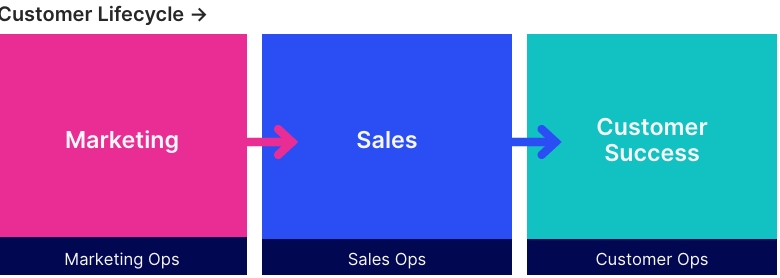
Most business processes haven't evolved with their customers. Marketing, Sales, and Customer Success only interact with customers at defined stages of the customer lifecycle. They're discrete departments, handing off the customer from one team to the next.
In this legacy model, performance is measured through hand-offs, like MQL-to-SQL conversion rates. Each department has its own team members handling operations, enablement, insights, and tools. This typically leads to misalignment, duplication of effort, and a disconnect between strategy and business outcomes.
The RevOps model
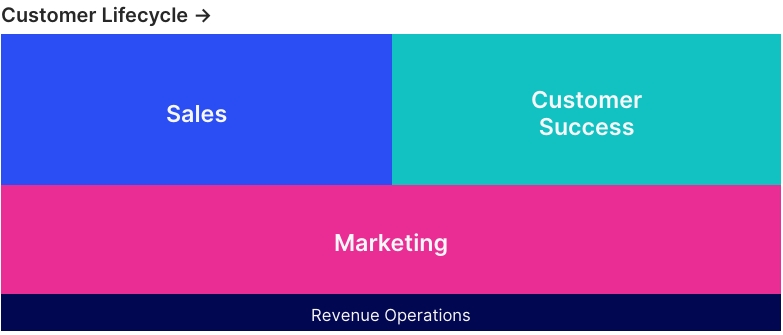
RevOps connects Marketing, Sales, and Customer Success across the customer lifecycle, breaking down internal silos to increase alignment, focus, and simplicity.
In the new world, Marketing is involved throughout the customer lifecycle, from awareness to expansion. Marketing programs not only drive new business, but also cross-sell and up-sell opportunities, and churn prevention through customer marketing.
Sales is now involved at the earliest stages of the customer lifecycle, influencing awareness and brand through social selling activities and Sales-initiated outbound campaigns.
Customer Success now sees which opportunities are coming their way before the customer makes their initial purchase, comparing new customers to existing ones and focusing on the most likely expansion opportunities.
RevOps links Marketing, Sales, and Customer Success operations across the customer lifecycle to drive efficiency and keep all teams accountable to revenue. Beyond this, RevOps builds alignment with other stakeholders such as Finance, Product, and the Executive team.
RevOps aligns everyone
RevOps keeps Marketing, Sales, and Customer Success aligned around the customer — unifying metrics, tech ownership, and change management. Customers can have a flawless set of interactions with your company when these teams are aligned. According to SiriusDecisions, this alignment can drive up to 36% of your growth.
Alignment requires agreement on metrics, credibility and trust between teams, defined ownership of the tech stack, and change management.
Agreement on metrics
In the legacy model each team has its own metrics, and these metrics have various levels of understanding across the business. Marketing metrics, such as MQL, are widely accepted but not widely understood; Sales metrics, like pipeline coverage, tend to be well defined and operationalized; Customer Success typically re-uses Sales metrics in lieu of well-defined metrics for expansion.
Different teams can use the same metric in their own ways — one example is estimated annual recurring revenue (eARR). With different definitions, it's impossible to rely on the data to make sound decisions, like the profit-and-loss floor to hire new reps.
"Duplicate measurement efforts across Sales and Marketing is distracting and can lead to divergent strategies. You need a single source of truth to measure, baseline, and optimize the revenue engine." Dan Shaw, Chief Revenue Officer at SkyWatch
RevOps owns metrics end-to-end, ensuring everyone in Marketing, Sales, and Customer Success — as well as Finance, Product, and the Executive team — understands core business metrics and how to use them.
Credibility and trust
"At SnapApp, Sales and Marketing sit together. The Sales and Marketing teams are within an earshot of each other. That physical proximity creates intimacy of knowledge and connection, which is an important part of building trust." Seth Lieberman, CEO of SnapApp
Data vs. gut feelings
In the absence of data, gut feelings are often used to debate what works and what doesn't. A great Insights team provides the data so you can move the conversation from gut feelings to fact-based arguments. Credible decisions can be made when working from facts, enabling strategic business decisions to form the foundation for commitments.
Vanity metrics vs. insights
Vanity metrics such as clicks, opens, and Sales activity data are easy to get and freely available. They're great for informing tactical program design, but useless for operational decisions and strategic insights about the business. RevOps provides operational metrics that support business operations and decisions — such as showing how Sales and Marketing tactics work in concert to drive revenue, detailed segment analysis, efficiency metrics like marginal CAC, and identifying constraints in your funnel.
Ownership of the stack
We have so many tools
Fifteen years ago, technologies like CRM and Marketing Automation were new. Today, over 8,000 MarTech tools are available. In our interviews with B2B SaaS companies, we found they used an average of 32 tools in their Sales and Marketing stack. The tech stack has become impossible to manage: multiple tools may do the same job, complex integrations break regularly, and the wild west of self-service tools leaves unknown amounts of customer data everywhere.
No one owns the stack
It's a challenge because no one owns the stack. Twenty years ago this would have been IT's domain; today it's common for Marketing to own the budget, procurement, and management of these systems. Sales and Customer Success can have their own systems teams as well, leading to multiple owners for one CRM implementation.
With RevOps, a single team owns the tech stack used by Marketing, Sales, and Customer Success. Accountability and ownership go hand in hand. RevOps manages a close relationship with IT to ensure tools meet security and data management requirements, while changes can be made quickly, responding to the needs of Marketing, Sales, and Customer Success in real time.
"It's not magic, it's software. Software won't replace your problems; it won't replace the deficiencies in your company — it can actually hinder your reps' abilities to sell more." Kenny Goldman, cofounder of KickSaw
Tools are shared by every team
Look at how these vastly different tools are used by every team across the customer lifecycle:
- Social media is used to build your brand, provide customer support, and find new prospects.
- CRM is used to report on lead conversion through revenue contribution, manage new business pipeline, and handle everything from renewals to advocate programs.
- Product usage data is used to drive marketing programs, focus Sales on high-quality leads, and alert your team when a customer is at risk.
- Every tool change creates a cascading impact across the team; roll-outs require project and change management, testing, and training to be successful.
Beyond managing changes, the volume of specialized tools creates huge gaps in end-user training. Great enablement helps every team drive revenue through the best use of these tools, maximizing ROI for expensive MarTech systems.
"New tools are coming out all the time. Each time a new team member joins the company, it takes hours just to configure their tech stack, not to mention training them on how to use all the tools." Jacqui Murphy, VP Marketing at Auvik Networks
Change management
"In the early days when we made changes to our tools, they only impacted a couple of people. Today, when we roll out changes they impact half our company — 170 people. There's a new scale of testing and due diligence required to make sure you don't negatively impact the Sales organization." Mike Griebenow, Revenue Operations Manager at Vidyard
"Your teams need to trust each other, they need to know that they're working towards a common goal, and they need to find ways to be supportive and collaborative." Lex Friedman, Chief Revenue Officer, Art19
RevOps creates focus
RevOps has four areas of responsibility: Operations, Enablement, Insights, and Tools. This creates focus by separating the management of internal and external stakeholders.
Operations management
Operations management works across the business at macro and micro levels — from strategic business objectives to tactical program design — managing resources to ensure every outcome aligns with the needs of the business. It can start with distributed roles, such as Sales Ops or Marketing Ops, and become specialized over time.
Enablement team
Sales Enablement removes friction from your sales reps, turning an ordinary Sales team into a high-velocity, high-throughput deal factory. RevOps takes Enablement to the next level, bringing enablement practices to Marketing and Customer Success. Each enablement effort has compounding effects on your whole business, and you'll see reps closing more business, faster, with fewer resources.
Operations
- Sales Operations
- Marketing Operations
- Project Management
- Business Analyst
- Strategy
- Business process innovation
- Project and change management
- Cross-functional collaboration
- Sales planning and compensation
Enablement
- Sales Enablement
- Learning Management
- Performance Management
- Onboarding
- Coaching
- Continuous training
- Professional development
- Content access and utilization
Insights team
The Insights team gives superpowers to everyone from a Marketing Program Manager to your Board. From day-to-day insights to strategic analysis, this team will give you confidence in the decisions you're making — and the quality of data to back them up.
Tools team
The Tools team is responsible for all technology used by Marketing, Sales, and Customer Success — from implementing Salesforce to social selling tools. The team should have a deep understanding of Salesforce, business processes, and technical capabilities.
Insights
- Business Analyst
- Data Scientist
- Database Developer
- Data management
- Data access
- Operational insights
- Strategic insights
Tools
- Systems Administrator
- Software Developer
- System administration
- Technical solution design
- Evaluation, procurement, and vision of the tech stack
- Integration
When hiring for RevOps, look for seasoned Marketing, Sales, and Customer Success professionals. RevOps team members should be analytical, technical, and business-oriented, helping to close the gap between current operations, tools, and business challenges.
RevOps simplifies everything
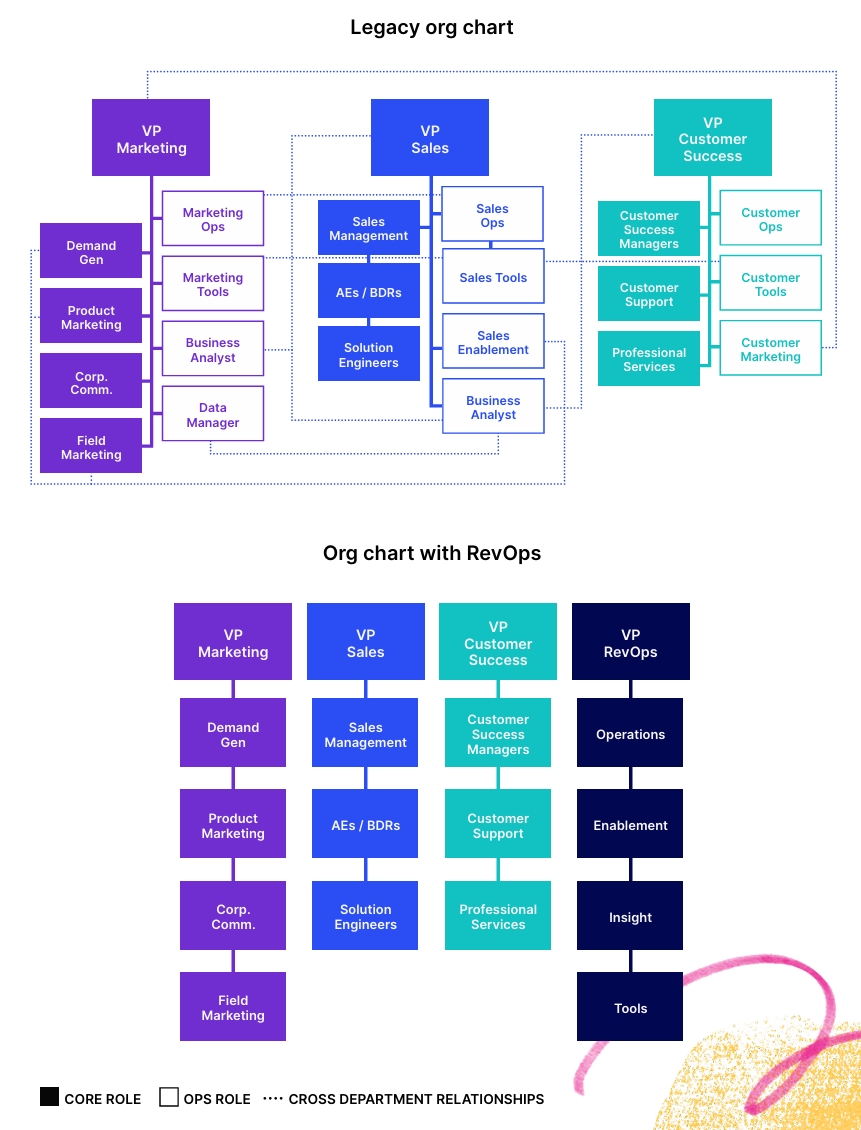
Most companies have legacy org structures based on how businesses were run twenty years ago. New functions have been added into this structure over time, creating leadership roles that are overly broad.
RevOps consolidates operations into one team to simplify everything.
The legacy model creates problems.
This legacy challenge is evident in Sales leadership. Should they be focused on managing teams for enablement, insights, and tools if it comes at the cost of helping their reps build and manage their pipeline? You can see this in the problems created by the legacy model:
- Department heads have direct reports with skill sets outside their own area of expertise, creating a lack of focus.
- Duplicate roles in each department, with dotted-line reporting relationships across the organization, creating misalignment and unnecessary complexity.
To grow fast, you need the right people in the right organizational structure, focused on delivering what the business needs.
"Sales reps are focused on hitting their number every quarter. For them, selling is essential — everything else is optional." Jairaj Sounderrajan, Global Head of Go To Market at Samsung NEXT
"Companies need more than product and brand marketing. They need an expert in demand gen, building pipeline, and partnering with Sales." Meagen Eisenberg, Chief Marketing Officer at MongoDB
Key issues with the legacy org chart
Management skills gap
With siloed operations, each VP is responsible for both core departmental roles and operational roles. This splits their focus between:
- External audiences — like generating leads, closing deals, and growing customers.
- Internal audiences — like creating dashboards, implementing changes in Salesforce, and training internal teams on how to use these tools.
Take the CMO as an example. In the past, CMOs and VPs of Marketing were expected to master corporate marketing, product marketing, field marketing, content marketing, and demand generation. Today we expect CMOs to be technology experts on top of everything else. Sure, you can find a unicorn — see: Meagen Eisenberg — but they're rare. The same is true for Sales and Customer Success leaders.
The RevOps model allows your CMO to leverage RevOps' expertise to bring their vision for tech-enabled marketing to life. The entire executive team benefits from revenue metrics that are consistent and aligned to business objectives.
Multiple everything
With the siloed model, each team has its own set of operations, creating additional overhead across teams and increasing friction points or opportunity for conflict. With RevOps, instead of duplicating operational roles, you can invest new headcount in specialized Marketing or Sales roles, enabling the business to move faster. This gets everyone on the same page, creating a single source of truth across the organization — from accountability, to metrics, to strategic priorities.
Fuzzy reporting relationships
In the legacy model, reporting relationships are anything but simple, with dotted-line reporting that reduces accountability. RevOps simplifies reporting structures: strategic decisions can be made at the executive level, while the Operations, Enablement, Insights, and Tools teams work with stakeholders from Demand Generation to Customer Success Managers.
Who leads RevOps?
The Chief Revenue Officer, or CRO, is an emerging role in the technology industry. The CRO provides unified leadership of Marketing, Sales, Customer Success, and RevOps. In many ways, the CRO is a natural leader for SaaS businesses, which rely on recurring revenue models.
In SaaS, the lines between Marketing, Sales, and Customer Success are more intertwined than in other business models. If you don't have a CRO, RevOps can live under the Operations or Marketing umbrella. This decision comes down to the needs of your business and the skill set of your leadership team.
CROs are new. According to LinkedIn job data, in 2017 the United States had roughly 4,100 CROs, 24,400 CMOs, and 43,000 COOs. By 2021 the growth had been substantial — there are now over 9,000 CROs, over 38,000 CMOs, and nearly 100,000 COOs.
"The integration between Marketing, Sales, and Customer Success is critical — the CRO's role is to drive alignment between these teams." Mark Roberge, previously Chief Revenue Officer at HubSpot
Getting started with RevOps
RevOps can start in two ways: distributed capabilities throughout your team, or specialized roles in a department. The right way to start depends on your business model and company size.
RevOps generally starts out as distributed capabilities, with one person doing multiple roles — for example:
- Sales Ops also does Enablement and Insights.
- Demand Gen also does Marketing Ops and manages Tools.
Eventually these responsibilities become dedicated roles and can be brought under the RevOps umbrella as you scale. Consolidating usually happens when communication and project management become sufficiently complex — usually around 100 employees. If you're over one hundred employees, it's likely you already have siloed Ops in your business. Changing this will require a leader who brings the Ops roles together and consolidates reporting relationships.
"When we got to around 75 employees, we recognized that we needed one source of truth for data. At that point we hired a VP of Business Operations. Since creating that team, we have streamlined our customer journey and data to derive key insights, leading to a repeatable, scalable Sales and Marketing experience." Carol Leaman, CEO at Axonify
Scaling RevOps roles
There are two rules of thumb for when to hire: by company size or by number of reps.
Scaling by company size. Hire Insights and Tools roles, like analysts and systems administrators, at specific company milestones, using employee count as a proxy for need.
Scaling by sales team size. Hire Operations and Enablement roles, like Sales Ops, as soon as you have 5–10 sales reps. Add Enablement roles to the team in a 10:1 ratio with the number of sales reps.
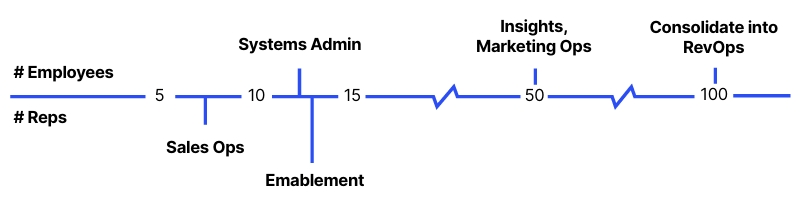
"Hire Ops as soon as you can. 5–10 reps is when you make the investment. If you can bring a systems person on earlier, do it as one of the first 15 people in the company." Joe Gelata, Director of Business OS at OTTO Motors
Signs you need RevOps
There are common symptoms when you don't have a RevOps function. If the statements below sound like your team, it likely means you've waited too long to bring on RevOps.
"Our process is broken!"
Businesses evolve — new lead generation processes, territory changes, and new product lines all cause change-management challenges. RevOps involves all teams in creating new processes, training materials, and roll-out plans, and in collecting feedback to iterate on changes.
"Do these Marketing campaigns even work?"
It's challenging to prove Marketing ROI, understand why deals are stalled, or get to the bottom of churn issues. RevOps teams look holistically across the business, helping you know what you don't know — and finding ways to answer those questions.
"What's the difference between an MQL and an SQL?"
The great war of Sales and Marketing alignment happens when each team has its own definition of success, losing trust in the process. RevOps creates agreed-upon definitions for every metric, service-level agreements for handoff management, and trains teams to ensure everyone is on the same page.
"Our data is a mess!"
Even when we know what metrics we want to track, the data isn't always there — or accurate enough — to answer critical business questions.
"Data integrity is always an issue. It creeps up on you. The responsibility for clean data belongs to everyone, and RevOps guides the way." Joe Gelata, VP of Business Operations at Axonify
By bringing the enablement, insights, and tools teams under one umbrella, they can work together with Sales reps to optimize the system for data entry and analysis.
"Why isn't this in Salesforce?"
By bringing the enablement, insights, and tools teams under one umbrella, they can work together with Sales reps to optimize the system for data entry and analysis.
"Ugh, we're implementing another tool?"
RevOps consolidates the procurement, implementation, and management of tools under one team. This gives full visibility across the organization, saves costs, and increases adoption through training and enablement.
RevOps drives growth
RevOps creates benefits for Marketing, Sales, and Customer Success — but more importantly, it aligns the company around the customer. RevOps helps you generate more revenue by influencing key metrics: value, volume, velocity, and conversion rates.
RevOps has compounding effects on every part of your business: Enablement helps your teams ramp and adapt quickly; Insights helps your team focus on the right opportunities; and the right tools save time. These improvements can feel small, but they benefit the reps you have today and the reps you will hire in the future.
Increase revenue
Carry capacity
Through efficiency gains, you can grow the amount of revenue each rep can carry, increasing revenue growth with fewer resources.
Ramp time
Through better enablement and onboarding, you can reduce ramp time for new hires, such as SDRs and AEs, scaling growth faster and shortening your rep payback period.
Core metrics
By increasing the key levers of growth — volume, value, velocity, and conversion rates — you'll be able to grow faster. LTV is a great example: you can use core metrics to focus on prospects that look like your highest-value, lowest-churn customers, expanding your customer base faster and retaining revenue longer.
Predictable growth
RevOps brings predictability to your growth through consistent, accurate measurement. You'll have the confidence to invest in new markets, new headcount, or new strategies — and be able to know early when they're working and when they're not. This could mean:
- Sales and Finance agree on how to use eARR to measure sales rep profitability, or the profit and loss required to support hiring a new rep.
- Customer Success and Product agree on how to identify revenue at risk due to product requirements.
- Sales and Marketing agree on a new market segment to enter, such as a new vertical.
Respond to market changes
As your business grows, it requires some big changes, such as:
- CRM re-implementation.
- Restructuring your teams, territories, and compensation models.
- Introducing and launching new products.
RevOps manages the internal change by providing communication, training, and project management to make transitions seamless. This reduces your risk of losing deals, losing staff, and losing time.
"That traditional funnel is where Marketing was at the top, Sales is in the middle, and Customer Success is at the bottom. That doesn’t really work anymore — the reality is that each of these teams kind-of sit everywhere." Hana Abaza, Head of Marketing at Shopify Plus
Varicent Lead to Revenue
Varicent Lead to Revenue is a RevOps platform that helps you capture missed opportunities from your funnel. Connect Salesforce and Lead to Revenue to drive your Revenue Operations engine. The platform provides the visibility required to identify gaps between your pipeline and revenue goals, and gives you the actions and insights you need to improve revenue efficiency, close gaps, and surpass goals.
Varicent Lead to Revenue aligns your teams to revenue. Learn more about Lead to Revenue →
"When Sales, Marketing, and Customer Success understand the unit economics of a business, they can work together toward common goals." Kyle Lacy, CMO at Lessonly
Conclusions
- RevOps is a new organizational model that drives growth through operational efficiency across the customer lifecycle.
- RevOps has four key areas of responsibility: Operations, Enablement, Insights, and Tools.
- RevOps works internally, enabling Marketing, Sales, and Customer Success to drive revenue.
- RevOps uses alignment, focus, and simplification to drive revenue growth, help you invest in growth, and respond to market changes faster.
Frequently asked questions
See smarter planning in action
Align RevOps, finance, and sales planning with Varicent.
Learn MoreAbout Varicent
Varicent is a leading provider of Sales Performance Management software, focused on helping organizations plan, operate, and pay to drive sales performance and growth. With a full suite of solutions for smarter territory and quota planning, efficient lead-to-revenue operations, and the fastest, most flexible way to pay sellers accurately and on time, Varicent is the trusted SPM solution for customers worldwide. To learn more, visit varicent.com.